What is your "neighborhood"?
Builds: a shared sense of the place we are trying to help flourish.
What we asked, what came back
Eighteen members of the TNN 2026 cohort spent the May convening on a single question: what is your "neighborhood"? The question was deliberately personal — not "what is a neighborhood" in the abstract, but the neighborhood you bring with you when you say the word.
The cohort generated 141 stickies, then a round-robin of one- or two-sentence definitions, then split into four breakout groups to read across the corpus. The four groups — facilitated by George, Sarah, Amanda, and Aiden — each came back with a distinct lens on the same material.
The synthesis treats those four lenses as the structural backbone of what was produced, with the round-robin and the sticky corpus as shared raw material running underneath. From that, six convergences and eight divergences emerged, along with a working framework: seven components that make a neighborhood thrive, each carrying three key attributes, with indicators that distinguish presence from grounding.
The framework is a working draft. It is most useful when applied against a real place, where the gap between what the framework names and what is actually there becomes the diagnostic itself.
What we made
The seven components
An interactive page showing what the cohort produced: seven components that make a neighborhood thrive. The page also shows where the work is heading — C4C's draft attempt to break each component into key attributes and, eventually, measurable indicators. The attributes are a working hypothesis, not a finished position. Activity 2 is where the cohort begins shaping the attributes against lived experience. Light and dark modes both available.
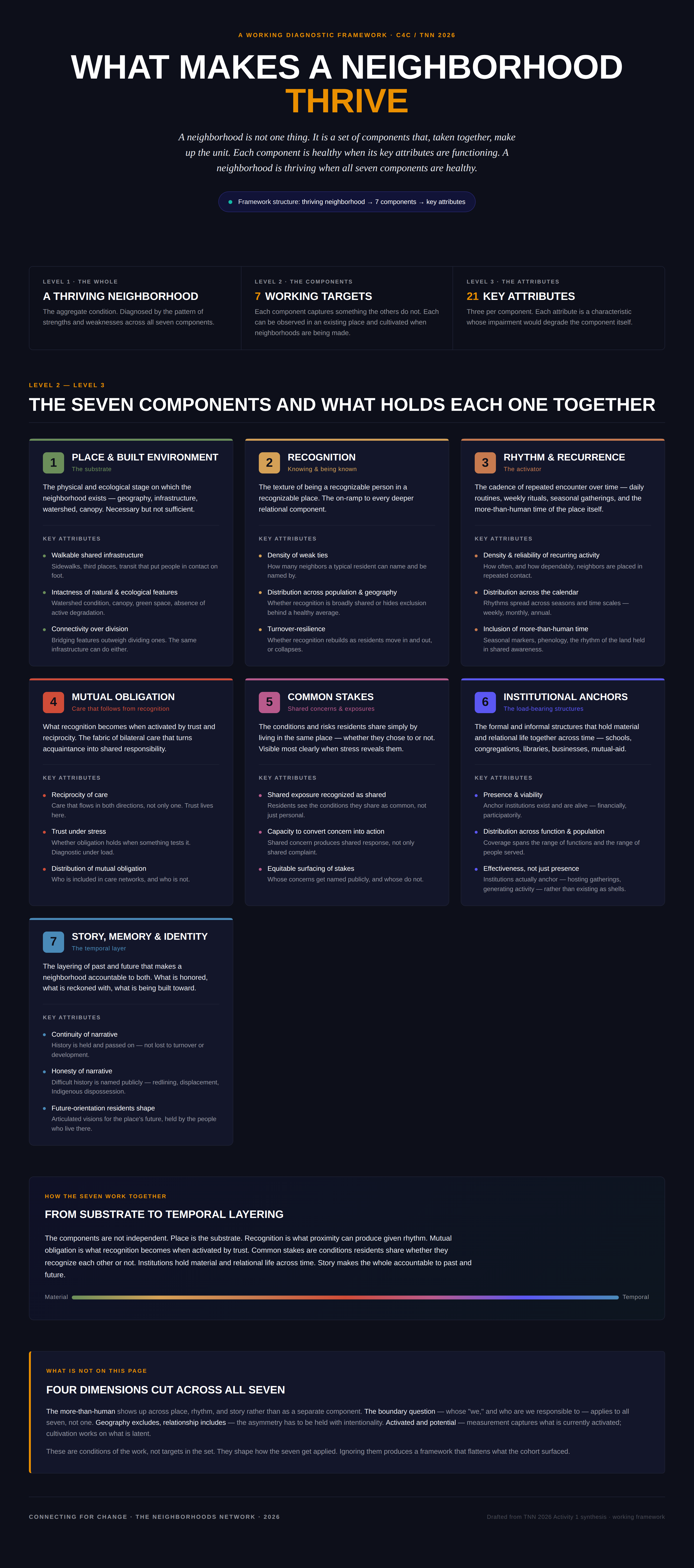
The seven components summary
A plain-prose summary of the seven components, suitable for sharing outside the cohort. Available in Word and PDF.
The components worksheet
A printable tabloid worksheet with the seven components laid out and blank notes space under each. Useful for the cohort to take notes against the components — for example, during Activity 2.
The working materials
The synthesis memo and its companion documents — the working materials behind the framework. These are internal-leaning documents for cohort members and conveners.
Into Activity 2
The shared sense of place is the substrate the next activity builds on. Where Activity 1 asked what we mean by neighborhood, Activity 2 asks what we really care about within it — the concrete dimensions of what thriving actually means.
The seven components carry forward as a working diagnostic. Activity 2's outputs will plug into the components and may pressure-test them. The "what we care about" dimensions may sharpen specific attributes, surface new ones, or call for revision.
Open questions remain. Whether economic deserves an eighth component, how Sarah's TNN-itself reframe shapes downstream choices, and whether the practitioner-vs-resident vocabulary gap is a feature or a problem — all live on, and any of them may shift as we move through Phase 1 into Phase 2.